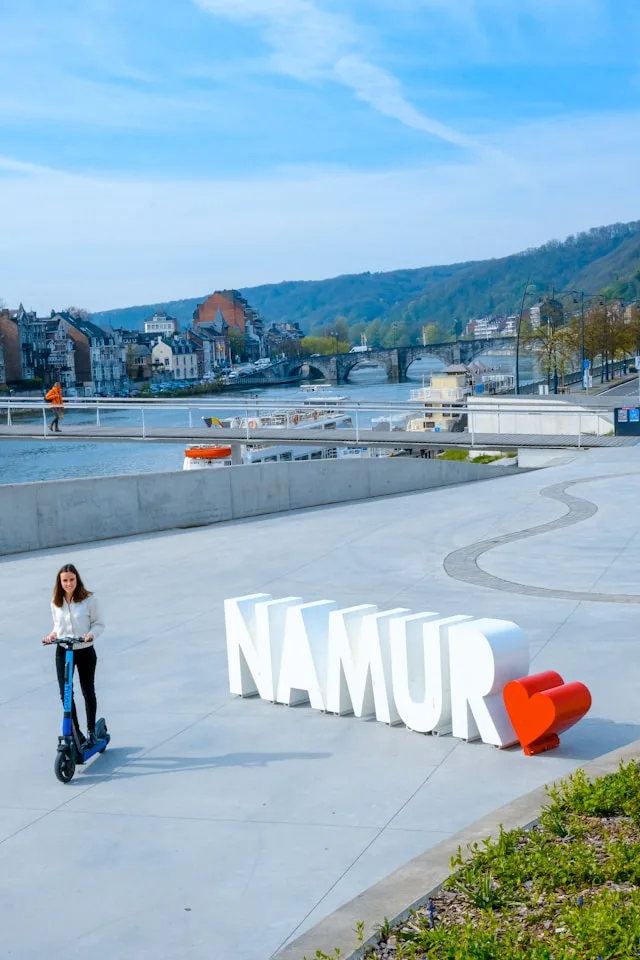
Namur, Belgium Executive Search

Executive Search in Namur

KiTalent brings sector-specific intelligence and direct headhunting capability to senior leadership searches across Namur.

7-10

days to qualified shortlists in many searches

80%

of relevant passive talent reached through direct headhunting

42%

faster time-to-hire than traditional search benchmarks

96%

one-year retention from KiTalent's broader methodology

These are KiTalent track-record figures referenced across our core about, services, and methodology pages.

Why Namur is a deceptively difficult executive market

Namur looks manageable on paper. A mid-sized Walloon city. A concentrated employer base. A well-educated population drawn from two universities. The assumption is that hiring senior leaders here should be straightforward. It is not.

The city's talent dynamics are shaped by three forces that consistently wrong-foot companies relying on conventional recruitment methods.

Thirty-two per cent of Namur's highly educated professionals commute daily to Brussels. That figure, drawn from SNCB commuter data, understates the problem for executive search. Among the most experienced and highest-compensated professionals, the proportion skewing toward Brussels roles is even higher. The result: the visible pool of locally available senior leaders is thinner than the city's economic output would suggest. Job postings attract limited response. Internal referral networks loop back to the same names. Reaching executives who live in the Namur area but work in Brussels requires a fundamentally different sourcing approach: direct headhunting into the hidden 80% of passive talent who will not respond to an advert.

The public sector still accounts for 34% of city employment. Within that population, 25% will be eligible for retirement by 2028. This is not a gradual transition. It is a concentrated wave of departures from the Walloon regional ministries, the Federal Planning Bureau offices, and the senior ranks of CHU UCLouvain Namur. Every departure creates a vacancy. Many of those vacancies require leaders who understand regulatory environments, public-private partnerships, and the specific governance culture of Wallonia. This is precisely the kind of institutional knowledge that cannot be sourced through a database. It must be identified through talent mapping conducted well before the retirement date arrives.

The shift is real. Public-sector employment's share has dropped from 42% in 2010 to 34% today. The gap has been filled by energy companies, healthcare logistics, digital services, and hydrogen-adjacent manufacturing. ORES has grown to 1,200 employees in the city. Accenture's delivery centre expanded to 800 FTE. CMI Energy's Namur operations grew 12% in a single year. These are not incremental moves. They are companies building permanent leadership teams in a city whose executive recruitment ecosystem was designed for government appointments, not private-sector competition. When multiple employers in the same postcode need the same bilingual Chief Sustainability Officer or cybersecurity director, whoever reaches qualified candidates first wins. The rest wait. This is why companies operating in Namur increasingly treat executive search as a strategic capability rather than an ad hoc purchase. It is why a Go-To Partner approach, built on continuous intelligence and pre-mandate relationship-building, outperforms the traditional "brief-then-search" model in a market this tight.

What is driving executive demand in Namur

Several structural forces are converging to shape executive demand across Namur.

Energy transition and grid infrastructure

Namur's role as the seat of Walloon energy governance has attracted the private-sector functions that follow regulation. ORES, the regional electricity and gas distribution operator, is headquartered here and executing the €2.1 billion "Linky Wallon" smart meter rollout. Elia Grid International maintains its secondary headquarters and SCADA operations centre in Salzinnes, employing roughly 400 engineers focused on cross-border interconnectors. CMI Energy has expanded its R&D footprint into the Ecolys business park, hiring over 150 thermal engineers for hydrogen-ready turbine retrofits. The Jambes Hydrogen Hub, now operational, hosts John Cockerill electrolyser maintenance facilities. Each of these organisations needs leaders who combine deep technical knowledge with regulatory fluency and commercial acumen. Our oil, energy and renewables practice sees this pattern across every European market where grid modernisation is accelerating: the executive talent supply never keeps pace with the capital deployment.

Life sciences and clinical research

CHU UCLouvain Namur is the anchor, employing 3,800 people and growing at 3% annually as ageing-care demand intensifies. This is not just a hospital. It functions as a clinical research organisation hub, hosting Wagralim satellite labs and serving as the gravitational centre for Phase I-II trial management in Wallonia. Bone Therapeutics stations its regulatory and clinical affairs functions here to access BioWin, the health cluster managing agency. Univercells Technologies coordinates biomanufacturing supply chains from Namur for its logistics connectivity on the E42/E411 corridors. The executive roles in this cluster are distinctive: Chief Medical Officers managing decentralised EMA procedures, clinical data managers with CDISC certification, and regulatory affairs directors who understand both Belgian and EU-level compliance. These are not profiles that appear on job boards. They are found through healthcare and life sciences executive search built on sector-specific networks.

Digital services, cybersecurity, and BPO

Namur has positioned itself as a mid-cost alternative to Brussels for French-language shared service centres. Accenture Federal Services expanded its Namur delivery centre to 800 FTE, serving federal government digital transformation contracts. Sopra Banking Software maintains implementation teams in the city for proximity to banking infrastructure. The Cyberwal cluster opened a Security Operations Centre in Namur's Creative Hub in late 2025, employing 60 analysts focused on critical infrastructure protection. Meanwhile, fintech back-office operations for Luxembourgish banks are growing here, exploiting the bilingual talent pool and a lower cost base than Luxembourg City. The leadership demands span AI and technology expertise combined with public-sector domain knowledge, a combination that is scarce in any European market.

Advanced manufacturing and aerospace coordination

The Skywin aerospace cluster uses Namur as its administrative headquarters while Charleroi hosts manufacturing. Cenaero spin-offs in the city provide multiphysics simulation and high-performance computing services. CMI's defence division adds order volume, though with volatility tied to NATO spending cycles. These niche manufacturers need operations leaders and R&D directors who can work across the Namur-Charleroi corridor. For companies hiring in this space, our aerospace, defence and space and industrial manufacturing practices bring the cross-regional network that a single-city search cannot provide.

Cross-border complexity

Namur sits at the intersection of Brussels, Luxembourg, and Flemish supply chains. Federal shared service centres require bilingual FR/NL project managers. Fintech operations serve Luxembourg-regulated entities. Energy projects involve cross-border interconnectors with Germany and the Netherlands. Every senior hire in this market must be evaluated not just for technical competence but for the ability to operate across Belgium's linguistic and regulatory boundaries. International executive search capability is not optional here. It is the baseline.

Sector strengths that define Namur executive search

Namur's executive search market is strongest where its economic specialisation is deepest.

Why companies partner with KiTalent for executive search in Namur

Companies rarely need only reach in Namur. They need interpretation, calibration, and a search architecture that reflects the real structure of the market.

We operate across Belgium

Our team coordinates Namur mandates from our European headquarters in Turin, with direct access to the talent intelligence, compensation dynamics, and sector developments that drive search outcomes.

We reach the candidates that matter

The strongest executives in Namur are passive. Our direct headhunting approach engages the hidden 80% of passive talent through discreet outreach rooted in real market knowledge.

We do not start from scratch

Our parallel mapping methodology means we already hold live intelligence on restructuring, transition windows, compensation patterns, and candidate attraction opportunities when a brief arrives.

Our model de-risks the investment

In Namur, the cost of a wrong executive hire extends far beyond the recruitment fee. Our interview-fee model lets clients see real market output and qualified candidates before the bulk of the investment is committed.

How we run executive searches in Namur

Every search in Namur is coordinated from our European headquarters in Turin, with consultants who understand Belgium's linguistic complexity, Wallonia's regulatory environment, and the specific interplay between the city's public and private sectors. The methodology is the same framework we apply globally, but its execution is calibrated to conditions on the ground.

1. Parallel mapping before the brief is live

KiTalent continuously tracks career movements, organisational changes, and compensation shifts across Namur's core sectors. Before a client defines a need, we have already identified who holds senior roles at ORES, Elia, CHU UCLouvain Namur, and the digital services cluster. We know which leaders are approaching contract renewals, which are affected by the public-sector retirement wave, and which have been approached by Brussels competitors. This is the engine behind our methodology: a live market view that converts a new mandate into an interview-ready shortlist within 7 to 10 days rather than the 8 to 12 weeks a conventional firm requires.

2. Direct headhunting into the hidden 80%

In a city where 32% of the senior talent base commutes to Brussels, the conventional visible market is a fraction of the actual available population. Our consultants identify and engage the professionals who are performing well, compensated fairly, and not looking. The outreach is confidential, individually crafted, and conducted with the precision that protects both candidate and client reputations. In Namur's tight professional circles, this discretion is not optional.

3. Market intelligence as a search output

Every Namur engagement produces a comprehensive market map alongside the candidate shortlist. Clients receive data on compensation ranges by role and sector, competitor hiring activity, candidate availability signals, and an honest assessment of what the market can and cannot deliver. This intelligence, delivered through our market benchmarking service, often proves as valuable as the placement itself. It shapes future hiring strategy, informs retention decisions, and eliminates the guesswork that leads to offer-stage failures.

Essential reading for Namur hiring decisions

These resources provide deeper market intelligence and explain how KiTalent turns insight into a faster, more transparent search process.

Frequently asked questions about executive search in Namur

These are the questions most closely tied to how executive search really works in Namur.

Why do companies use executive recruiters in Namur?

Namur's senior talent pool is smaller than its economic output suggests. A third of the city's highly educated workforce commutes to Brussels. The public sector, still the largest employer, faces a concentrated retirement wave. Private-sector growth in energy, healthcare, and cybersecurity has intensified competition for the same finite population of experienced leaders. Companies that rely on job postings or internal referrals find themselves recycling the same shortlists. An executive search firm with pre-existing intelligence on who holds what role, and who might be open to a conversation, reaches candidates that conventional methods consistently miss.

What makes Namur different from Brussels for executive hiring?

Brussels has scale: a vast and diverse talent pool across nearly every sector. Namur has concentration: a smaller number of senior professionals operating across overlapping energy, healthcare, and government ecosystems. Confidentiality is harder to maintain. Compensation expectations have risen sharply as private-sector employers compete with Brussels packages to retain local talent. A search in Namur requires deeper market knowledge, more careful candidate management, and a genuine understanding of Wallonia's regulatory culture. The same approach that works in a large metropolitan market will underperform here.

How does KiTalent approach executive search in Namur?

Every Namur mandate begins with the intelligence we have already gathered through continuous talent mapping across the city's core sectors. We identify candidates across the Namur-Brussels-Charleroi corridor, not just within city limits. Our consultants assess technical competence, linguistic capability, cultural fit with Walloon institutional environments, and genuine motivation for a Namur-based role. The process is built for discretion in a market where professional circles overlap and reputations are built or damaged by how a search is conducted.

How quickly can KiTalent present candidates in Namur?

Our standard delivery is an interview-ready shortlist within 7 to 10 days. This is possible because we do not start from zero when a mandate arrives. Our parallel mapping methodology means we have already tracked career movements and availability signals across Namur's energy, healthcare, technology, and public-sector leadership markets. When a client defines a need, we activate an existing network of relationships rather than beginning cold outreach. In markets with the kind of timing pressure Namur's retirement cliff creates, this speed is not a convenience. It is a necessity.

How does the bilingual requirement affect executive search in Namur?

Technical Dutch fluency is the single most common filtration point that collapses Namur shortlists. The city is predominantly French-speaking, but federal shared service mandates, Flemish supply chain integration, and cross-regional governance roles all require operational Dutch capability. Many candidates who present as bilingual on paper lack the technical vocabulary needed for engineering or regulatory contexts. Our assessment process tests linguistic competence in domain-specific scenarios, not just conversational ability. This prevents the costly discovery, weeks into an onboarding, that a placed executive cannot function effectively across Belgium's language boundary.

Start a conversation about your Namur search

Whether you are hiring a Chief Sustainability Officer for an energy headquarters, a cybersecurity director for the Cyberwal cluster, a Chief Medical Officer for the clinical research ecosystem, or a delivery centre lead for a federal SSC, the starting point is the same: a confidential conversation with a consultant who already understands this market.

What we bring to Namur executive mandates:

Executive search and direct headhunting · Talent mapping and market intelligence · Compensation benchmarking and mandate calibration · Connection to KiTalent's European headquarters in Turin and international executive search network.

Tell us about your Namur hiring challenge

Whether you are running a live mandate or want to pressure-test a brief before going to market, this is the right place to start the conversation.

Explore Our Executive Search Guides

Produced by KiTalent Research. Based on local market intelligence and executive-search data. Reviewed by KiTalent Research Team.