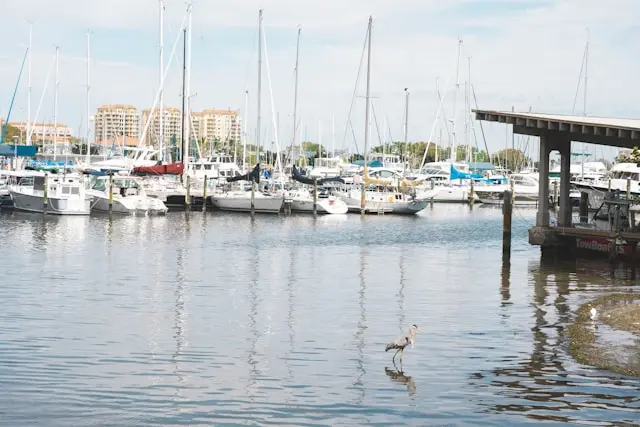
St. Petersburg, the United States Executive Search

Executive Search in St. Petersburg

KiTalent brings sector-specific intelligence and direct headhunting capability to senior leadership searches across St. Petersburg.

7-10

days to qualified shortlists in many searches

80%

of relevant passive talent reached through direct headhunting

42%

faster time-to-hire than traditional search benchmarks

96%

one-year retention from KiTalent's broader methodology

These are KiTalent track-record figures referenced across our core about, services, and methodology pages.

Why St. Petersburg is a deceptively complex executive market

Job postings work in cities with surplus talent. St. Petersburg is not that city. With average weekly wages at $1,340 and year-over-year wage growth at 4.2%, the professionals who would fill your most critical roles are already employed, well-compensated, and not browsing. The visible candidate pool is shallow. The real market is hidden.

What makes St. Petersburg particularly difficult is the collision of three forces that most search firms fail to account for.

Raymond James Financial employs over 10,400 people locally. Jabil adds another 5,100. Together, these two firms anchor a metro of 274,000 residents, creating a talent gravitational field that is disproportionate to the city's size. When a fintech startup in the Carillon corridor or a biotech firm in the Innovation District needs a VP-level hire, they are often recruiting from the same population that Raymond James and Jabil are working hard to retain. The counteroffer trap is not a theoretical risk here. It is an operational constant.

St. Petersburg's economy is shifting toward a "Blue-Green-Tech" model: marine science, climate resilience technology, and financial services innovation. These sectors require leaders who combine domain expertise with emerging technical capabilities. A Chief Resilience Officer at a real estate developer needs both climate science fluency and C-suite commercial instinct. A WealthTech product head at Raymond James needs hybrid finance and software experience. These profiles do not exist in abundance. They certainly do not appear on job boards.

Commercial property insurance premiums in Pinellas County have risen 40% since 2024. The city's Flood Resilience Zoning Overlay adds 8 to 12% to construction costs. These are not abstract policy developments. They are redefining which executives companies need and what those executives must know. ESG and climate risk analysts are now high-demand roles at Raymond James and across the insurance sector. This is a hiring environment that rewards firms with pre-existing intelligence about who holds these niche capabilities, not firms that begin searching after a mandate arrives. This is why a Go-To Partner approach to executive search matters more in St. Petersburg than in larger, more liquid markets. The talent pool is finite. The competition for it is intense. And the cost of arriving late to a search is measured in quarters, not weeks.

What is driving executive demand in St. Petersburg

Several structural forces are converging to shape executive demand across St. Petersburg.

Financial services and wealth technology

Raymond James Financial's $300M Campus 2.0 expansion consolidated cybersecurity and AI-driven wealth management divisions from Denver and Memphis into St. Petersburg. The Carillon FinTech Corridor now houses 18 startups in the RJ Labs accelerator. RJ Ventures launched a $150M fund in 2025 targeting wealth-management AI and climate-risk analytics firms, requiring portfolio companies to maintain primary operations locally for at least 18 months. This concentration is generating demand for senior product leaders, compliance heads, and technology officers who understand regulated financial environments. Intrinio's Series C raise of $28M signals that the financial data infrastructure layer is maturing as well. Our banking and wealth management practice tracks these movements continuously, and the insurance executive search team covers the climate-risk analytics crossover that is becoming a defining feature of this corridor.

Health innovation and pediatric biotech

Johns Hopkins All Children's Hospital is no longer just a clinical institution. Its $180M Research Institute expansion, completed in late 2025, specialises in pediatric genomics and rare disease therapeutics. Clinical research coordinator and biostatistician roles have grown 14% in a single year. Specialised pediatric nurses command wage premiums 18% above the Florida median. The USF Health Marine Street Research Quad doubled its wet-lab space in 2025, creating a new category of environmental health research that spans red tide neurotoxins and climate pediatrics. Business development VPs focused on rare disease licensing are among the hardest roles to fill here. Our healthcare and life sciences consultants understand the specific credentialing and regulatory fluency these leaders require.

Marine science and blue technology

The Innovation District anchors what is arguably the most concentrated cluster of oceanographic expertise in the American Southeast: NOAA's Southeast Fisheries Science Center, the Florida Fish and Wildlife Research Institute, and USF's College of Marine Science all share a downtown waterfront footprint. The commercial layer is now catching up. The Blue Economy Incubator has seeded 12 startups since its 2025 launch, including AquaSurvey (subsea drone manufacturing, Series B) and Phykos (algae-based carbon capture, $45M Series B). AquaSurvey is being discussed as a potential 2027 IPO candidate. These firms need operations leaders, R&D directors, and commercial heads who can bridge deep-ocean science with venture-backed scale-up pressure.

Advanced manufacturing and supply chain technology

Jabil's new Automation Center of Excellence focuses on AI-driven supply chain resilience tools and medical device micro-manufacturing. EcoGrowth Environmental, headquartered in the Skyway Marina District, produces recycled composite materials for marine infrastructure. Both companies reflect a broader shift from contract manufacturing toward high-mix, low-volume technical production. The leadership profiles required are changing accordingly: supply chain resilience analysts, automation engineering directors, and manufacturing VPs who can manage the transition from volume to precision. KiTalent's industrial manufacturing and industrial automation sector teams have direct experience recruiting for this kind of operational evolution.

Creative and digital media

The Warehouse Arts District's 1.2 million square feet of repurposed industrial space hosts animation studios, immersive experience designers, and gaming firms. SaltBlock Hospitality expanded its studio complex by 40% in 2025. The Grand Central district, initially a crypto-art hub, has pivoted toward AI-generated content tools for marketing technology. While the creative sector is not the largest employer, it generates a distinctive category of senior hires: studio directors, creative technology officers, and marketing tech product leads.

St. Petersburg's leadership markets by sector

St. Petersburg is not one talent pool. It is five or six overlapping pools, each with its own compensation norms, candidate motivations, and competitive dynamics. A search strategy designed for financial services will fail in marine technology. An approach calibrated for healthcare will miss the mark in advanced manufacturing.

Sector strengths that define St. Petersburg executive search

St. Petersburg's executive search market is strongest where its economic specialisation is deepest.

Why companies partner with KiTalent for executive search in St. Petersburg

Companies rarely need only reach in St. Petersburg. They need interpretation, calibration, and a search architecture that reflects the real structure of the market.

We operate across United States

Our team coordinates St. Petersburg mandates from our European headquarters in Turin, with direct access to the talent intelligence, compensation dynamics, and sector developments that drive search outcomes.

We reach the candidates that matter

The strongest executives in St. Petersburg are passive. Our direct headhunting approach engages the hidden 80% of passive talent through discreet outreach rooted in real market knowledge.

We do not start from scratch

Our parallel mapping methodology means we already hold live intelligence on restructuring, transition windows, compensation patterns, and candidate attraction opportunities when a brief arrives.

Our model de-risks the investment

In St. Petersburg, the cost of a wrong executive hire extends far beyond the recruitment fee. Our interview-fee model lets clients see real market output and qualified candidates before the bulk of the investment is committed.

How we run executive searches in St. Petersburg

St. Petersburg's combination of concentrated talent pools, cross-sector competition for leaders, and rapid wage growth requires a methodology built for speed and precision. Searches coordinated from our Americas hub in New York benefit from proximity to the Florida market, direct understanding of U.S. regulatory and compensation frameworks, and established networks across the Southeast's financial services and healthcare sectors.

1. Parallel mapping before the brief is live

KiTalent does not start research when a client calls. Through continuous parallel mapping, the firm tracks career movements, compensation evolution, and organisational changes across St. Petersburg's key sectors independently of any active mandate. When Raymond James restructures its wealth management technology division or Johns Hopkins All Children's expands its research institute, we are already cataloguing who moved where, who is ready for a new challenge, and who has the capability profile our clients will need. This is the engine behind a 7-to-10-day shortlist delivery. It is not acceleration. It is preparation.

2. Direct headhunting into the hidden 80%

In a city of 274,000 where two Fortune 500 firms absorb a disproportionate share of senior talent, the visible candidate market is thin. Direct headhunting built on individually crafted outreach is the only reliable method for reaching the professionals who are performing well, compensated generously, and not considering a move. These are the hidden 80% who will determine whether a shortlist is genuinely strong or merely available. Our consultants approach these candidates with sector-specific credibility, not generic recruiter messaging.

3. Market intelligence as a search output

Every St. Petersburg engagement produces more than a shortlist. Clients receive comprehensive market intelligence: who holds what role at which competitor, how compensation is structured across comparable positions, and where the genuine gaps and opportunities exist. In a city where WealthTech product heads command $400K-plus packages and specialised nurses carry 18% premiums, this intelligence is not supplementary. It is what prevents offer-stage failures and informs long-term talent strategy.

Essential reading for St. Petersburg hiring decisions

These resources provide deeper market intelligence and explain how KiTalent turns insight into a faster, more transparent search process.

Frequently asked questions about executive search in St. Petersburg

These are the questions most closely tied to how executive search really works in St. Petersburg.

Why do companies use executive recruiters in St. Petersburg?

St. Petersburg's executive market is defined by concentration. Two Fortune 500 headquarters, a major research hospital, and a fast-growing cluster of blue tech startups all draw from a finite pool of senior professionals in a city of 274,000. The candidates who would make the strongest hires are not looking. They are well-compensated and well-positioned at Raymond James, Jabil, Johns Hopkins All Children's, or funded startups offering equity upside. Reaching them requires direct, discreet headhunting from consultants who understand their sector and can articulate a proposition worth their attention. Job postings do not solve this problem. Executive recruiters with pre-existing market intelligence do.

What makes St. Petersburg different from Tampa for executive hiring?

Tampa's talent market is larger, more diversified, and more liquid. St. Petersburg's is smaller, more specialised, and more interconnected. The two cities share a metro area but not a talent dynamic. St. Petersburg's corporate headquarters and research institutions create a professional community where senior leaders know each other personally. This means search process quality matters more: a clumsy approach in St. Petersburg is noticed and remembered. It also means that compensation data from Tampa does not reliably apply. St. Petersburg's wage growth at 4.2% year-over-year and its concentration of specialised roles in fintech, marine science, and pediatric biotech create distinct compensation benchmarks.

How does KiTalent approach executive search in St. Petersburg?

Through continuous parallel mapping of St. Petersburg's key sectors, we maintain live intelligence on career movements, compensation structures, and organisational changes before any mandate is active. When a client briefs a search, we are not starting from zero. We activate pre-existing candidate relationships and present a qualified shortlist within 7 to 10 days. Each candidate undergoes a three-tier assessment: technical competency evaluation, personal career-storytelling to assess cultural fit and motivation, and optional psychometric assessment for senior roles. This rigour is why our placements achieve a 96% one-year retention rate.

How quickly can KiTalent present candidates in St. Petersburg?

Interview-ready candidates are typically presented within 7 to 10 days of mandate confirmation. This speed comes from parallel mapping, not from cutting corners. Because we continuously track St. Petersburg's financial services, healthcare, and blue tech talent markets, the foundational research is already complete when a brief arrives. Clients receive weekly pipeline reports and full market intelligence throughout the engagement.

How does the climate-risk economy affect executive search in St. Petersburg?

Climate economics are reshaping every sector in St. Petersburg. Commercial property insurance premiums have risen 40% since 2024. The city's Flood Resilience Zoning Overlay adds 8 to 12% to construction costs. $8.2B in coastal assets face exposure by 2040. This is creating entirely new executive roles: Chief Resilience Officers, ESG analysts, climate-risk underwriting directors, and coastal adaptation engineers. These profiles barely existed five years ago. The candidate pool is thin nationally and almost nonexistent locally. Proactive talent mapping and cross-market search capability are essential for filling these roles before competitors secure the same limited talent.

Start a conversation about your St. Petersburg search

Whether you are hiring a Chief Technology Officer for a Carillon fintech firm, a VP of Research for a pediatric biotech programme, a Chief Resilience Officer for a coastal development company, or a marine technology CTO for a venture-backed startup, this is where the conversation begins.

What we bring to St. Petersburg executive mandates:

Executive search and direct headhunting · Talent mapping and market intelligence · Compensation benchmarking and mandate calibration · Connection to KiTalent's Americas hub in New York and international executive search network.

Tell us about your St. Petersburg hiring challenge

Whether you are running a live mandate or want to pressure-test a brief before going to market, this is the right place to start the conversation.

Explore Our Executive Search Guides

Produced by KiTalent Research. Based on local market intelligence and executive-search data. Reviewed by Nicholas Finato.