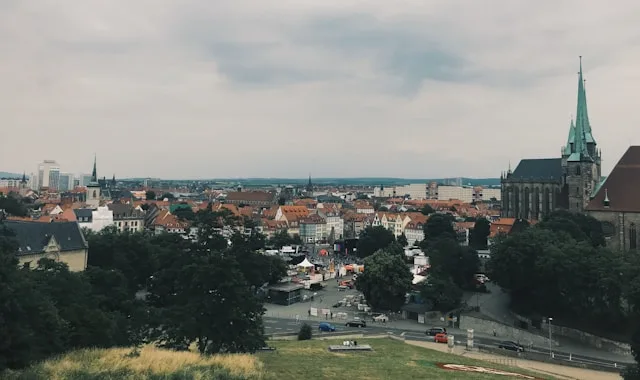
Why Erfurt is a deceptively complex executive market
Post a senior leadership role in Erfurt through conventional channels and you will hear from candidates with strong public-administration backgrounds and solid regional credentials. What you will not hear from is the optical engineer running Jenoptik's lithography line, the supply-chain director managing hazardous-material warehousing for CATL's battery supply chain, or the Ed-Tech product leader scaling IU's SaaS platform to 130,000 students. Those professionals are employed, well-compensated, and invisible to job boards. Reaching them requires a fundamentally different approach to search.
Erfurt sits 35 minutes by ICE from Leipzig. That proximity is both an asset and a threat. Leipzig's larger logistics and chemical clusters, anchored by BMW, Porsche, and the DHL hub, offer wage premiums of approximately 12% for mid-level technical talent. The daily commuter flow between the two cities means Erfurt's best performers are constantly exposed to competing offers. For employers hiring directors and C-suite leaders in Erfurt, the implication is clear: a search process that takes three months will lose candidates to a faster-moving Leipzig employer before the first interview.
Erfurt's Mittelstand firms, many in the €50 to €200 million revenue range, form the backbone of the city's precision engineering and logistics economy. These companies report acute difficulty recruiting C-level executives with international B2B sales experience. The IHK has responded with a "Mittelstand-Spitzenkräfte" executive-search subsidy programme running through 2027. The gap is not just about compensation. It is about visibility. These firms are largely unknown outside Thuringia, which means direct headhunting into competitor organisations is the only reliable path to qualified candidates.
Thirty-four percent of Erfurt's manufacturing workforce is aged 50 or above. The Thüringer Fachkräfteoffensive immigration fast-track is easing entry-level gaps through recruitment agreements with Bosnia-Herzegovina and Vietnam, but it does nothing for the senior leadership pipeline. When a photonics SME needs a plant director or a logistics operator needs a VP of operations, the candidate pool is structurally thin. Succession planning is not a future concern here. It is a present one. This is exactly the environment where a Go-To Partner for talent acquisition creates the most value: building intelligence on who is available, who is movable, and what it will take to close them, before the vacancy even opens.