Why Münster is a deceptively difficult market
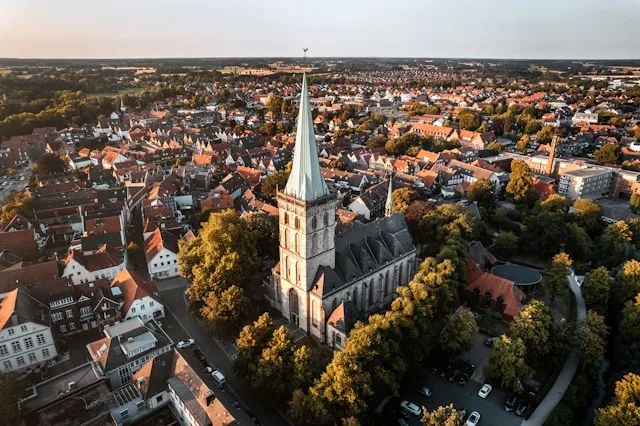
The first mistake companies make in Münster is assuming it behaves like a mid-sized German city. It does not. With approximately €14.2 billion in GDP and 185,000 employed workers, Münster has the economic density of a much larger city compressed into a spatially constrained footprint. The talent pool is deep in certain disciplines and alarmingly thin in others. Standard recruitment methods, job postings, inbound applications, and database searches consistently underperform here because the professionals who matter most are embedded in institutions that have learned how to retain them.
Münster's insurance cluster contributes roughly 28% of local GDP. LVM Landwirtschaftlicher Versicherungsverein alone employs around 4,500 people locally. Provinzial NordWest completed its merger operations in Q3 2025. SV SparkassenVersicherung runs a major IT campus in the city. AOK NordWest maintains its administrative hub here. This is not a dispersed market. It is a professional community where a clumsy approach to one candidate becomes known across the cluster within days. The reputational cost of a poorly managed search process is material, and it compounds. When your talent acquisition strategy touches the same network repeatedly, process quality is not a luxury. It is the precondition for access.
Münster's green belt restrictions and strict Denkmalschutz protections in the Prinzipalmarkt core have produced one of Germany's tightest housing markets. A residential vacancy rate of 0.4% means that recruiting from outside the city requires solving a housing problem before solving a hiring problem. The city's "Münster Talent Card" offering temporary housing subsidies for key tech workers is a policy response to this reality, but it does not eliminate the friction. For executive-level hires, the implication is clear: the strongest candidates are already in Münster. Reaching them requires direct headhunting into the hidden 80% of passive talent that will never appear on a job board.
The professionals Münster's insurers need, data scientists with regulatory knowledge, CTOs who can integrate legacy systems with AI, ESG specialists who understand asset management, are the same professionals its deep-tech startups, its hospital system, and its Fraunhofer institute are pursuing. With 340+ active startups in the Digital Hub Münsterland ecosystem and UKM expanding its clinical trial pipeline, competition for hybrid technical-commercial leaders is intensifying across sectors that draw from overlapping candidate pools. This convergence makes pre-existing market intelligence essential. A firm that begins research only after receiving a mandate is already behind. KiTalent's Go-To Partner approach exists precisely for markets where continuous talent mapping is the difference between a successful hire and a six-month vacancy.