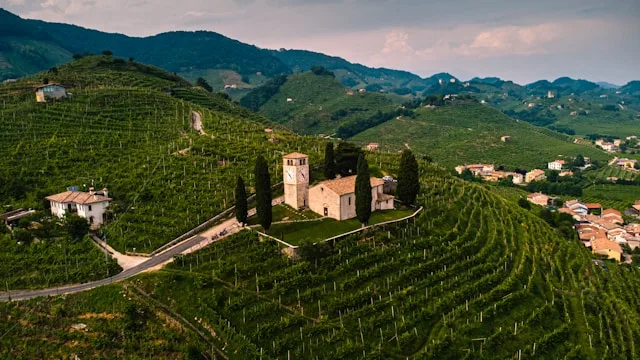
Why Conegliano is a deceptively complex executive market
A municipality of 35,200 people generating €1.2 billion in direct wine turnover does not behave like a typical small Italian city. Conegliano's executive market is defined by extreme sector concentration, an ageing talent base, and a gravitational pull from larger cities that strips out mid-career professionals before they reach senior roles. Standard recruitment methods fail here not because the economy is small, but because the dynamics are unusually specific.
Conegliano's wine, machinery, and agri-food clusters employ a finite population of senior professionals. A sustainability director at Astoria Wines and an ESG compliance lead at Zardini Group attend the same Consorzio meetings, sit on the same CREA advisory panels, and share suppliers. This interconnection means any clumsy recruitment approach travels through the professional community within days. Confidentiality is not a preference here. It is a precondition. The hidden 80% of passive talent that conventional methods never reach is, in Conegliano, closer to 90%. The professionals who matter are employed, visible, and deeply embedded in relationships that a job posting will never disrupt.
Retaining senior talent against the salaries and career breadth of Milan and Verona is Conegliano's defining human capital challenge. An agritech CTO earning €65,000 to €78,000 locally can command €95,000 or more in Milan's broader tech ecosystem. The city's competitive response relies on quality of life, proximity to vineyards, and the intellectual density created by CREA and the Scuola Enologica. But these advantages only work when they are articulated as part of a compelling executive proposition. Filling leadership roles here requires more than sourcing names. It requires building a case for why this city, this company, and this role represent something a candidate cannot find in a larger market.
Conegliano's shift from volume to value production is real: organic vineyard coverage has nearly doubled from 18% to 32% in a single year, precision viticulture adoption has jumped from 40% to 75%, and electric harvesting machinery now accounts for 65% of vineyard fleets. But the executives who can manage this transition, people fluent in EU Taxonomy compliance, blockchain traceability, and IoT vineyard management simultaneously, are not abundant anywhere in Italy. The city is competing for a talent profile that barely existed five years ago.
This is exactly the environment where a Go-To Partner approach outperforms transactional search. Mandates here require pre-existing market intelligence, discreet outreach, and a deep understanding of what motivates leaders to choose a 35,000-person municipality over a metropolitan career.